
 Posted by
 The 6th season of Major League Soccer was nearly the last. In an April 2016 interview with Soccer Today, FC Dallas President Dan Hunt said that MLS folded in November 2001. Although Dan’s father, Lamar, resurrected the league within 48 hours, the 2001 offseason was still traumatic for MLS. The league shrunk from 12 teams to 10 after Tampa Bay Mutiny and Miami Fusion were disbanded.
Major League Soccer soldiered on with 10 teams during the next three seasons, until Real Salt Lake and Chivas USA were added heading into the 2005 campaign. The league has only grown since then, expanding to 26 teams for the 2020 season. MLS is not stopping there, however, with four more teams set to join by 2022.
This rapid expansion is underpinned by a rise in attendance numbers. An April 2018 report by CIES Football Observatory showed that MLS had the second-highest growth in attendance of the 51 leagues studied, with the average league attendance in the 2013-2018 seasons 34% higher than the average attendance in the 2003-2008 seasons. The 21,358 average in the 2013-2018 seasons was the 8th-highest of any league in the world, placing MLS ahead of established competitions like Brazil’s Brasileirão, Argentina’s Superliga and Holland’s Eredivisie. Encouragingly, these attendance figures were evenly distributed across the league. The three most popular teams in Major League Soccer contributed only 24.1% of the league’s total attendance between 2013 and 2018, a lower percentage than 49 of the 51 leagues studied.
High and uniform attendance numbers are the lifeblood of a successful league. According to CIES Football Observatory, Germany’s Bundesliga and England’s Premier League had the highest and second-highest average attendances between 2013 and 2018. Furthermore, the three clubs with the largest average attendance in each league contributed less than 28% of the league’s total attendance between 2013 and 2018. In addition to being the two best-attended leagues in the world, the Bundesliga and Premier League are also the two most profitable. Germany’s top-flight posted revenues of $3.46 billion in 2018, while the Premier League generated an eye-watering $5.83 billion.
The ambition of Major League Soccer is unquestionable, and Commissioner Don Garber has repeatedly outlined his desire to make the league the worlds best. Although MLS is far from matching the economic power and on-field quality seen in the Bundesliga or Premier League, its growing attendance figures are a definite sign that it can reach those heights one day. What, then, has Major League Soccer done to increase attendance?
Build Soccer-Specific Stadiums
Stadiums in MLS have changed dramatically since the league was founded in 1996. In the first few years, every team played in cavernous venues with capacities that far exceeded their ability to attract fans. Although many teams chose to put tarps over vast sections of these stadiums to give a more intimate feel, the images of mostly empty football stadiums hosting MLS matches were damaging for the league.
To combat this problem, MLS began constructing stadiums that were tailored to their teams. The first of these soccer-specific stadiums was completed in May 1999, when Columbus Crew moved into Columbus Crew Stadium. Currently, 18 of the league’s 26 teams play in a soccer-specific stadium. These venues, which usually have a capacity between 18,000 and 27,000, have improved the fan experience at MLS matches enormously. Besides the modern amenities, fans are closer to the action and crowds are noisier, with the majority of the stadium filled, as opposed to a large arena that is at best half-full.
The table below depicts the effect that building a soccer-specific stadium has on the attendance numbers. The table includes data on the 12 teams that came into the league without a soccer-specific stadium and later moved into one. Overall, 9 of the 12 teams have increased their average attendance figures since moving into a soccer-specific stadium. On average, the teams experienced an increase of 1,410 fans per game after trading a multi-use stadium for a soccer-specific one, even with the teams’ stadium capacity decreasing by an average of more than 43,000 seats.
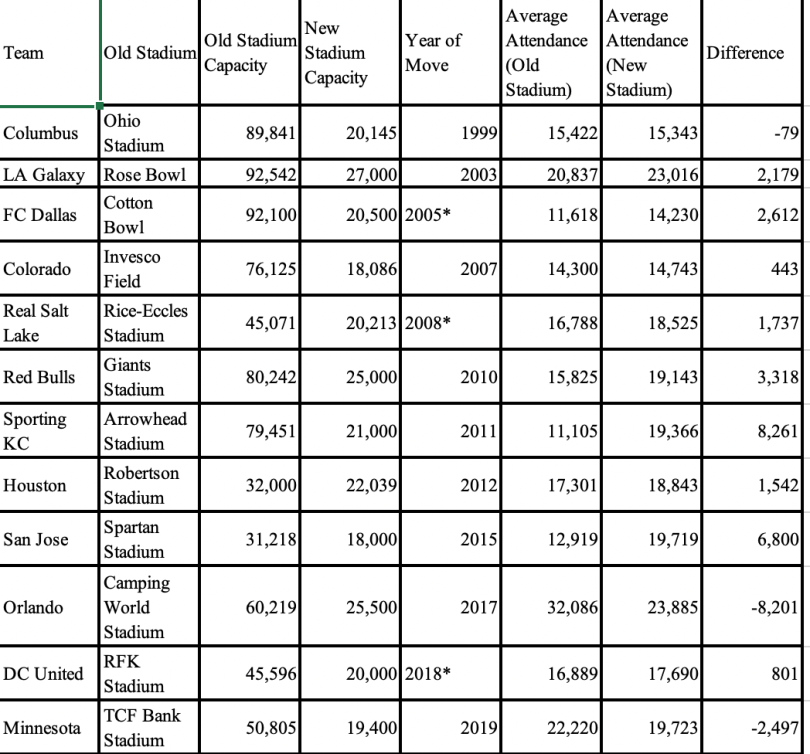
*Moved midway through season (average attendance for year of move not included)
Moving to Cities Without Many Major Sports Franchises
When Major League Soccer began, creating a domestic following for the sport was a significant challenge. The United States already had four major professional leagues before MLS came along, with the NFL (Football), MLB (Baseball), NBA (Basketball) and NHL (Hockey) far outstripping soccer in terms of popularity.
To combat this problem, MLS has been shrewd when deciding where to place new franchises. They have included “big market” cities that already had three or more major sports franchises before MLS moved in, but have also expanded to “small market” cities that had two major sports franchises or fewer. By 2022, when the league will balloon to 30 teams with the introduction of St. Louis and Sacramento, 12 of the 21 MLS expansion sides added since 2005 will have moved into “small market” cities, while only 9 will have entered into “big market” cities.
Although MLS has not discounted the possibility of further expansion, important American cities have been left out to date, including Phoenix, Tampa Bay, Detroit and Cleveland. These four cities are among the 20 biggest TV markets in the country, according to Nielsen’s 2020 DMA rankings. Furthermore, they each have at least three major sports franchises. In contrast, cities with two or fewer major sports franchises like Salt Lake City (#30 TV market), Cincinnati (#37 TV market) and Austin (#40 TV market) have been included in the league.
Team-by-team attendance numbers for the 2019 season vindicate Major League Soccer’s expansion strategy. The seven “small market” teams that came into the league between 2005 and 2019 had a slightly higher average attendance than the eight “big market” expansion teams that joined during the same period (24,215 vs. 24,016). Furthermore, four of the “small market” expansion teams were inside the top 7 for average attendance in 2019, while only two “big market” expansion teams made the top 7.
| Team | Year Founded | Average Attendance | MLS Attendance Rank |
| Real Salt Lake | 2005 | 18,256 | 14 |
| Seattle | 2009 | 40,247 | 2 |
| Vancouver | 2011 | 19,514 | 11 |
| Portland | 2011 | 25,218 | 4 |
| Montreal | 2012 | 16,171 | 19 |
| Orlando | 2015 | 22,761 | 7 |
| Cincinnati | 2019 | 27,336 | 3 |
| Team | Year Founded | Average Attendance | MLS Attendance Rank |
| DC United | 1996 | 17,744 | 15 |
| New England | 1996 | 16,737 | 18 |
| Colorado | 1996 | 14,284 | 23 |
| FC Dallas | 1996 | 14,842 | 22 |
| Chicago Fire | 1998 | 12,324 | 24 |
A comparison between the “small market” expansion teams and the oldest “big market” teams is more revealing. The first table above shows the 2019 average attendance and attendance rank for the seven “small market” teams that have come into MLS since 2005, while the second table depicts the same data for the five oldest “big market” teams from cities with just one MLS club. The 2019 average attendance for the seven “small market” expansion teams was 24,215, while the 2019 average attendance for the original “big market” sides was just 15,096. If Seattle (which had the 2nd-highest average attendance in 2019 and is the 13th-biggest TV market in the United States) is taken out of the equation, the “small market” teams still have a combined average attendance of 21,543, well in excess of the “big market” teams. If MLS can figure out a way to reignite interest in huge markets like Dallas and Chicago, the attendance figures for the league could increase considerably.
Appealing to the Latino Community
Latinos are the largest minority in the United States, with an estimated 59.8 million people accounting for 18.3% of the US population. They are also growing, with a 2015 Census Bureau report projecting that Latinos will comprise 28.6% of the total population by 2060, with 119 million people.
According to a September 2019 Pew Research Report, there were an estimated 36.6 million Mexicans or people of Mexican descent living in the United States in 2017, making them by far the biggest nationality group within the Latino community. The Mexican diaspora in the United States, likes their countrymen south of the border, are soccer-mad. As a result, Liga MX, the top division of Mexican domestic soccer, is the most-watched soccer league in the United States, ahead of the Premier League and MLS. For example, the 2018 MLS Cup between Atlanta United and Portland Timbers drew an average of 1.6 million viewers, making it the most popular MLS Cup since 1997. A week later, the second leg of the Liga MX Apertura 2018 Final between América and Cruz Azul averaged 2.5 million viewers.
Recognizing that Liga MX is far more popular than MLS even within the United States, MLS formed a strategic partnership with Liga MX in March 2018. Under this partnership, various competitions have been organized between the two leagues. The first of these was the Campeones Cup, a supercup between the MLS Cup winner and the winner of the Liga MX Campeón de Campeones, which began in 2018. The Leagues Cup, a two-legged knockout tournament with four teams from Liga MX and four from MLS, started in May 2019. Finally, the 2020 MLS All-Star game will pit an MLS All-Star side against a Liga MX All-Star team for the first time ever. Although the Leagues Cup may eventually expand to include matches in Mexico, all of these tournaments are played exclusively in the United States, which allows MLS to leverage the interest generated by Liga MX to expose Latinos to MLS.
MLS has furthered its connection with Mexican Americans by bringing some of Liga MX’s most talented players to the United States. Before 2017, only three players had been transferred directly from Liga MX to MLS under the Designated Player Rule, which allows MLS clubs to sign a maximum of three players outside of the league’s strict salary cap. Since then, however, 13 Designated Players have been purchased from Liga MX, including Mexican international attacking midfielder Rodolfo Pizarro, who became the third-most expensive signing in MLS history when Miami FC paid Monterrey $11.78 million for his services.
Besides developing ties to Liga MX, MLS has also looked to attract the Latino market on a wider scale. In September 2016, there were 101 MLS players from South and Central America. That number had jumped to 168 by March 2020, with players from South and Central America comprising 23.2% of the league’s total player pool. Furthermore, these numbers do not include the large number of American-born MLS players of South or Central American descent.
Making Latino fans feel represented by the players that take the field every week in MLS matches is an important form of engagement. However, MLS has taken the further step of interacting directly with the Latino fan. According to Sports Illustrated writer Luis Miguel Echegaray, MLS was the first professional league in the United States to have a “full-time, Spanish language, cultural, bilingual staff.” Furthermore, clubs like D.C. United, Real Salt Lake and LAFC have embedded themselves into the Latino community in their cities, whether through partnerships with local non-profits, interaction with Latinos fan groups, or consulting fans on important aspects of club identity. These local initiatives are extremely important, as they validate the work of MLS with Latinos on a national level. As the Latino community in the United States continues to grow, Major League Soccer will see its fanbase, and attendance numbers, increase.

