

 Posted by
 On January 11, 2007, Major League Soccer sent shockwaves through the world of football and forever changed the trajectory of the sport in the United States. The signing of international superstar David Beckham was a statement of intent, and demonstrated the commercial and sporting viability of MLS. Beckham became the league’s first designated player under a rule that enabled teams to sign players whose transfer fees and salary exceeded the league’s strict salary cap.
The signing of Beckham was a huge success for MLS. He raised the global profile of a league that had been in danger of folding just a few years before he joined. On the field, he led the Los Angeles Galaxy to back-to-back league titles in 2011 and 2012. However, the creation of the Designated Player Rule, which was enacted to permit his signing, is Beckham’s most important contribution to MLS. More than 200 players have been signed under the Designated Player Rule since January 2007, with the number of designated player slots available to each team jumping from one to three in that time. As MLS continues its rapid growth after 25 years in existence, designated player signings are a barometer for how much the league has changed since 2007, and areas that still need improvement.
With the increased publicity and commercial possibilities opened-up by Beckham’s transfer, teams around MLS tried to replicate the impact of the former Real Madrid midfielder by signing experienced players whose popularity could transcend the American soccer market. Denílson, Juan Pablo Ángel and Cuauhtémoc Blanco also joined the league in 2007, while former Argentinean internationals Marcelo Gallardo and Claudio López signed a year later. After the transfer of Freddie Ljungberg to Seattle Sounders in 2009, New York Red Bulls completed the biggest signings for the league since Beckham, with the joint capture of Barcelona superstars Thierry Henry and Rafael Márquez in 2010. The table below includes the prominent designated player signings since 2007.
| Name | Age When Signed | Year When Signed | Country | Number of NT Caps at Time of Signing | Total Caps | Number of Caps Gained After Signing as DP |
| David Beckham | 32 | 2007 | England | 96 | 115 | 19 |
| Denílson | 29 | 2007 | Brazil | 62 | 62 | 0 |
| Juan Pablo Ángel | 31 | 2007 | Colombia | 31 | 31 | 0 |
| Cuauhtémoc Blanco | 34 | 2007 | Mexico | 92 | 122 | 30 |
| Marcelo Gallardo | 30 | 2008 | Argentina | 45 | 45 | 0 |
| Claudio López | 33 | 2008 | Argentina | 55 | 55 | 0 |
| Freddie Ljungberg | 31 | 2009 | Sweden | 75 | 75 | 0 |
| Thierry Henry | 32 | 2010 | France | 124 | 124 | 0 |
| Rafael Márquez | 31 | 2010 | Mexico | 95 | 147 | 52 |
| Torsten Frings | 34 | 2011 | Germany | 78 | 78 | 0 |
| Robbie Keane | 31 | 2011 | Ireland | 109 | 146 | 37 |
| Tim Cahill | 32 | 2012 | Australia | 56 | 108 | 52 |
| Kléberson | 33 | 2013 | Brazil | 32 | 32 | 0 |
| Kaká | 32 | 2014 | Brazil | 88 | 92 | 4 |
| Jermain Defoe | 31 | 2014 | England | 55 | 57 | 2 |
| David Villa | 32 | 2014 | Spain | 97 | 98 | 1 |
| Steven Gerrard | 35 | 2015 | England | 114 | 114 | 0 |
| Frank Lampard | 36 | 2015 | England | 106 | 106 | 0 |
| Andrea Pirlo | 36 | 2015 | Italy | 115 | 116 | 1 |
| Didier Drogba | 33 | 2015 | Ivory Coast | 105 | 105 | 0 |
| Bastian Schweinsteiger | 32 | 2017 | Germany | 121 | 121 | 0 |
| Wayne Rooney | 32 | 2018 | England | 119 | 120 | 1 |
| Nani | 32 | 2019 | Portugal | 112 | 112 | 0 |
| Zlatan Ibrahimović | 36 | 2019 | Sweden | 116 | 116 | 0 |
| Javier Hernández | 31 | 2020 | Mexico | 109 | 109 | 0 |
Although some of these players produced on the field, many failed to match the expectation generated by the reputations they had forged with renowned European clubs or at World Cups. Furthermore, the vast majority of these players were over 30 at the time of their signing, giving them little-to-no resale value. The average age of designated player signings dipped below 30 only once in the first four years of the rule, when the five players signed in 2009 had an average age of 29.
In the years since 2010, MLS’s proclivity for signing world superstars in the autumn of their careers has not completely disappeared. However, this type of player is becoming less popular with front offices around the league. Seven “big-name” players were signed in 2014 and 2015, but only five more have joined the league in the subsequent five seasons. The waning prevalence of the superstar signing has been accompanied by an effort to bring in younger designated players.
In 2012, MLS introduced the Young Designated Player Rule, which allowed teams to sign a third designated player for a lower salary budget charge, provided the player was 23 or younger. Unsurprisingly, the establishment of the Young Designated Player Rule has lowered the average age of the designated players who are signed by MLS.
| Year | Average Age (With Young DPs) | Average Age (Without Young DPs) |
| 2007 | N/A | 31.8 |
| 2008 | N/A | 30.7 |
| 2009 | N/A | 29 |
| 2010 | N/A | 30 |
| 2011 | N/A | 29.2 |
| 2012 | N/A | 29.4 |
| 2013 | 26.3 | 27.5 |
| 2014 | 27.8 | 28.6 |
| 2015 | 27.1 | 28.4 |
| 2016 | 28 | 28.4 |
| 2017 | 25.3 | 27.2 |
| 2018 | 25.4 | 27.3 |
| 2019 | 25.8 | 27.4 |
| 2020 | 25.7 | 26.6 |
Yet, even when young designated players are taken out of the equation, the average age of designated player signings has continued to decrease. 2017 was only the second year that the average age of designated player signings without young DPs was below 28. The average age has stayed below 28 in the three subsequent years, while 2020 was the first year where the average age went below 27.
The trend towards younger designated players has created a virtuous economic cycle that the league is just beginning to exploit. A designated player who comes into MLS in his early-to-mid 20’s has a far greater sell-on value than an experienced campaigner in Europe’s biggest leagues who is nearing the end of his career. Paraguayan international Miguel Almirón is the perfect example of this phenomenon. In January 2017, Atlanta United bought the then 22-year-old attacking midfielder for $8.4 million from Argentinean Superliga side Lanús. After two standout seasons, Almirón was sold to Newcastle for an MLS-record fee of $26.9 million.
With the success of Almirón and other young, mostly South American designated players in recent seasons, MLS has been able to sign a higher caliber of young talent. Ezequiel Barco signed for Atlanta in 2018 at just 18 after starring for Argentine giants Independiente on their run to the 2017 Copa Sudamericana title. Another gifted Argentinean, Cristian Pavón, was made a designated player this past offseason after an impressive half season on loan to Los Angeles Galaxy. The world superstar signings of the Beckham era raised the profile of MLS, but they also gave the league a reputation as a glorified retirement home for famous players. Designated players like Barco and Pavón also burnish the league’s image, while at the same time banishing its reputation as a haven for footballing geriatrics.
Beyond the encouraging commitment to sign ever-younger designated players, MLS has been increasingly canny in recent years when deciding where to find its designated players. In the last few seasons, MLS has contracted a raft of designated players from Mexico’s top division, Liga MX. Until 2017, only three designated players were signed from south of the border. Since then, however, MLS has bought more designated players from Liga MX than any other league, with 13 players signed.
Given that Liga MX is the most-watched league in the United States, ahead of MLS or England’s Premier League, signing players from the Mexican league makes sense from a marketing standpoint. Furthermore, weakening the league that is your main competition for regional supremacy, while strengthening yourself, can only help MLS. Since the turn of the century, Liga MX has dominated the CONCACAF Champions League, North America’s version of the UEFA Champions League, winning every edition since 2005. In contrast, an MLS side has not won the tournament since Los Angeles Galaxy lifted the trophy in 2000. Similar to Bayern Munich’s habit of taking main domestic rival Borussia Dortmund’s best players to maintain supremacy in the Bundesliga, MLS can sign Liga MX stars to tip the regional competitive balance in their favor.
Without doubt, MLS is making advancements in the profile of the designated players they sign. However, there is still room for more positional variety. Since the Designated Player Rule came into effect, 73% of all designated player signings have been attackers. In contrast, just 15% of designated player signings have been defensive-minded players (defensive midfielders, defenders or goalkeepers).
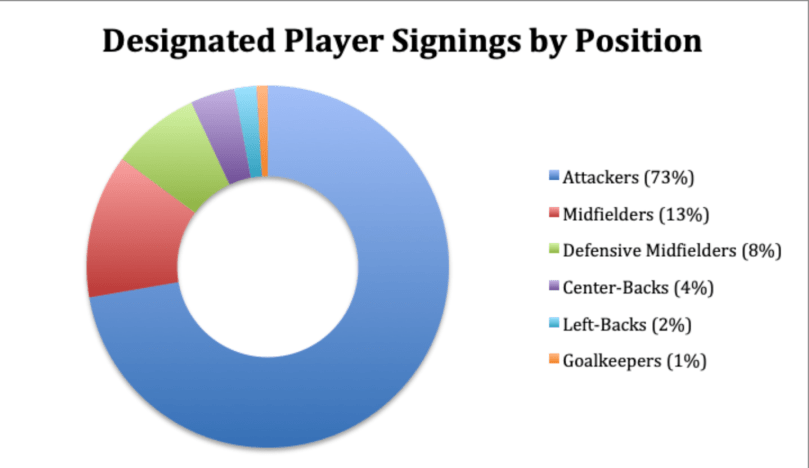
The prioritization of attackers over defenders has translated directly into Major League Soccer’s high goals per game ratio. Of the five major European leagues and the three most prominent leagues in the Americas (Brasileirão, Superliga Argentina and Liga MX), only the Bundesliga has a higher goals-per-game ratio over the last five seasons than MLS (2.98 vs. 2.95). The last two MLS campaigns have been particularly high-scoring, with seasonal goals-per-game ratios of 3.19 in 2018 and 3.04 in 2019. The Bundesliga is the only other league to record over 3 goals a game in any of the last five seasons. While goals bring fans into stadiums and boost TV ratings, a lack of defensive nous hurts MLS when they face Liga MX heavyweights in the CONCACAF Champions League.
Moreover, attendance numbers indicate that MLS has established itself in the American sports market to the point where it can sign more defensive-minded designated players without risking the existence of the league. According to an April 2018 report by CIES Football Observatory that studied attendance numbers in 51 different leagues across the world, the average attendance in MLS during the 2013-2018 seasons was 34% higher than the average attendance in the 2003-2008 seasons, representing the second-highest attendance growth among the 51 leagues. Furthermore, MLS ranked 8th in the world for average attendance between 2013 and 2018, with an average of 21,358 fans per game.
MLS deserves enormous credit for boosting their attendance figures, and should also be praised for signing younger designated players outside of the traditional European market. Nevertheless, bringing in more standout defensive midfielders or center-backs in the coming years would be welcome.
 Just for Kicks