
 Posted by
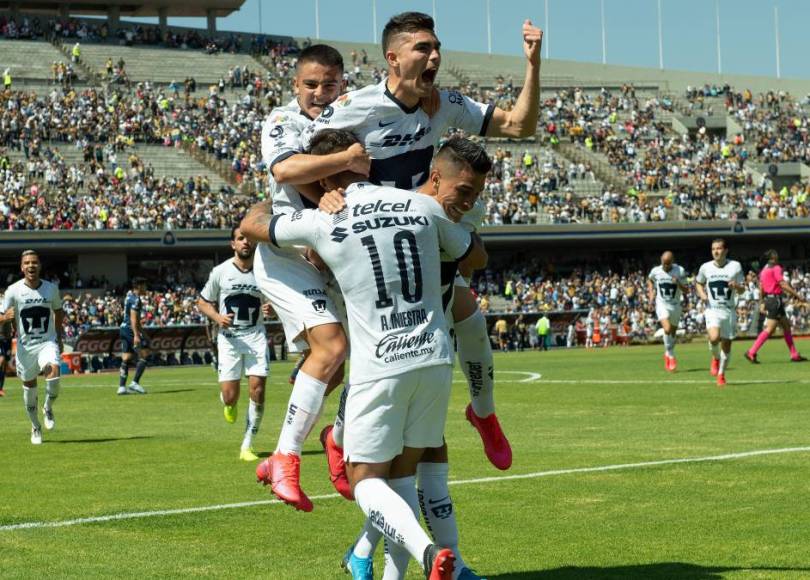
 Here are my three points from Pumas’ comprehensive 4-0 win over San Luis at the Estadio Olímpico Universitario on Sunday:
1) Pumas Already Have Liguilla in their Sights
After five games last season, Liguilla qualification seemed attainable for Pumas. Three wins had los Universitarios sitting 5th in the table, adding to the optimism generated by the summer hiring of experienced Spanish coach Míchel. However, Pumas’ form dipped dramatically, with los Universitarios finishing in 13th place, 4 points from the last Liguilla spot.
To reinforce the squad, sporting director Jesús “Chucho” Ramírez made six signings in January. Constrained by a limited budget, Ramírez contracted a mix of young Mexicans and inexpensive foreign imports, which failed to excite a fan base starved of success in recent years. Former Monterrey center-back Johan Vásquez and Argentinean striker Juan Dinenno were the standout purchases, but Pumas’ squad appeared thin in key areas heading into the Clausura 2020.
Yet, almost all of Pumas’ January buys have been huge successes so far. Vásquez has been a rock at the back and one of the best defenders in the league. Attacking midfielder Favio Álvarez has been the team’s creative hub. Winger Sebastián Saucedo has given opponents fits with his pace and trickery on the left. The success of the January signings has assuaged fears that Pumas’ squad did not have the requisite depth.
Pumas’ best player against San Luis was another January buy, left-back Alejandro Mayorga. The 22 year-old left Chivas for more playing time in the Mexican capital, and has started every league match since his transfer. Like Alan Mozo on the other side of Pumas’ back line, Mayorga is relentless in defense and attack, putting constant pressure on his opponents when they have the ball and looking to drive forward when he has possession. The presence of Mayorga and Mozo makes Pumas much harder to contain, as opponents cannot focus their defensive efforts on just one flank.
Although he is still adjusting to Liga MX following his move from Colombian side Deportivo Cali, Dinenno adds further variety to the Pumas attack. He allows Michel to play with one or two center-forwards, with Dinenno and Carlos Gonzalez showing an excellent understanding during the former’s cameo appearance on Sunday. Furthermore, Dinneno scored his first Liga MX goal in the rout of San Luis with a precise shot from outside the box, and was crucial in the buildup to the fourth Pumas goal.
Besides their burgeoning attacking versatility, Pumas have displayed an ability to get results in different ways. Sunday’s dynamic attacking performance was preceded by a battling 1-1 draw at Santos in round 4, where Pumas successfully soaked up pressure for much of the match against a dangerous opponent. Their confidence is soaring after an undefeated start to the season, which has los Universitarios sitting 2nd in the table on 11 points. Their unbeaten record will be severely tested during a three-match stretch against league heavyweights Tigres, América and León in rounds 8, 9 and 10. In their current form, however, Pumas are a match for any team in the league. Furthermore, they look a safe bet for a Liguilla spot following their red-hot start to the season.
2) Nightmare Return for Vázquez
This match was a homecoming for San Luis coach Guillermo Vázquez, who returned to face the team that he led to the Apertura 2011 title. Vázquez’s reputation as one of Mexico’s best coaches was solidified during his spell with Necaxa, which he led to consecutive 30-point seasons before joining San Luis this winter. The Central Mexican club were looking for stability following a turbulent first campaign back in the top flight, which saw them burn through three different coaches on the way to a 15th-placed finish.
With one win and three draws from the first four matches of the Clausura 2020, San Luis were primed to give Pumas a difficult afternoon under the intense Mexico City sun. Vázquez set his team up in a conservative 4-2-3-1, with the visitors looking to sit deep in their own half before breaking quickly through speedy wingers Germán Berterame and Anderson Julio. The plan worked to perfection initially, with Julio passing up the only chance of an insipid opening 30 minutes when he directed a diving header straight at Alfredo Saldívar.
However, things unraveled quickly for San Luis in the closing stages of the first half, with non-existent marking from set pieces their undoing. First, Johan Vásquez and Andrés Iniestra were allowed free shots at goal after a Pablo Barrera delivery, before Favio Álvarez turned home the opener from point-blank range in the 34th minute. Another Barrera dead ball in first half stoppage time was turned in by an unmarked Carlos González, who got in between three sleepwalking San Luis defenders to poke home.
With his initial strategy torn to shreds, Vázquez was unable to engineer a turnaround in the second half. His team was second best to every loose ball, and looked lethargic all over the pitch. They were punished by two more Pumas goals to complete a 4-0 scoreline that was a fair reflection on the visitors’ meek display. San Luis lack the quality to challenge at the top of the table, but organization and effort, two main components of any Vázquez team, should always be present. Their absence on Sunday will be a major concern for the Mexican coach.
3) VAR Here to Stay But Improvements Must be Made
Like other major leagues around the world, VAR in Liga MX has been a lightning rod for controversy since it was introduced midway through the Apertura 2018. The dissenting voices have reached a crescendo at the beginning of the Clausura 2020, with Mexican referees receiving criticism for being overly dependent on VAR.
These critiques provoked a response from the head of refereeing in Mexico, Arturo Brizio, who defended VAR in an interview with Fox Sports last week. While VAR is undoubtedly beneficial if used correctly, its employment in Sunday’s match will only increase calls for the technology to be discarded.
The first contentious incident occurred six minutes into the first half, when referee Luis Enrique Santander gave a penalty to San Luis for a trip by Mozo on forward Nicolás Ibáñez. However, replays showed that Ibáñez was offside when the ball was played to him, thus invalidating the foul. Inexplicably, Santander went to the VAR cabin to review the play when he could have been informed of the offside through his earpiece, taking three minutes before reversing his initial penalty call.
A similar incident happened early in the second half, when Ibáñez drew a second penalty, only for the call to be changed for another offside. This time, Santander did not go to the VAR cabin to review the play, and the whole check took only a minute and a half. The discrepancy in Santander’s handling of two nearly identical decisions reveals the need for a consistent VAR protocol.
A further issue is how VAR effects added time. With Mexican referees over reliant on the technology, VAR checks take up a significant amount of time in almost every match. This is a frustrating byproduct of VAR, but understandable if the process is streamlined and the correct amount of added time is awarded at the end of each half. However, added time rulings in recent weeks have been laughably off base. Only three minutes were added on at the end of the first half here, even though at least six minutes were lost for VAR reviews. Similarly, only six minutes of added time were allotted at the end of the Cruz Azul-Pachuca match on Saturday, even though at least twelve minutes should have been added. The presence of VAR is no reason to ignore basic principles of refereeing.
 Just for Kicks