
 Posted by
 Recent developments in Liga MX have brought mixed news for supporters of Mexican soccer’s top flight. On the pitch, there have been some positive developments, with a number of historically have-not sides exceeding expectations, often at the expense of the haves, and Mexican nationals scoring at a pace not seen in recent years. Off the pitch, however, there have been several ugly incidents that should have been foreseen and prevented by Liga MX officials. In addition, those same officials have shown a willingness to dilute the quality of Liga MX in return for financial gain. All this has combined to raise the question of whether this is the worst season in Liga MX history.
Unlike many major European leagues, Liga MX has long been extremely competitive and evenly matched. The Liguilla system gives 8 of the league’s 18 teams a legitimate shot at the title at the end of the season. However, concerns were growing in recent seasons over a widening gap between the league’s richest teams and the rest.
Encouragingly, the Apertura 2019 has been one of the most open in recent memory. Provincial sides Necaxa, Querétaro, Morelia and Santos defied expectations by making the Liguilla. Santos were the most impressive of the four, playing an exciting brand of attacking football under new Uruguayan coach Gustavo Almada on the way to finishing first in the regular season.
Meanwhile, the league’s heavyweights have struggled. Three of Mexico’s six richest clubs failed to make the Liguilla (Cruz Azul, Pachuca and Chivas) while Monterrey, the league’s wealthiest side, scraped into the playoffs on the last day. América, the country’s biggest side along with Chivas, drew almost as many matches as they won.
There have also been positive on-field developments on an individual level. Chivas marksman Alan Pulido found the net twice in his side’s meeting with Veracruz on the final day. Those two strikes put Pulido on 12 goals for the season, tying him with Chilean forward Mauro Quiroga for the league lead. Pulido’s accomplishment marks the first time since the Clausura 2011 that a Mexican has finished as Liga MX top scorer. Furthermore, Mexican internationals Henry Martín and José Juan Macías also finished in the top 10 of the league goalscoring charts, suggesting that Mexico is still able to produce quality players despite a lack of opportunities for young Mexicans at some clubs.
However, organizational ineptitude and corruption off the pitch have overshadowed these refreshing storylines and damaged Mexican soccer’s reputation. During the third weekend of October 2019, Liga MX made international headlines for all the wrong reasons. On the Friday, league bottom-dwellers Veracruz, who had threatened all week to not play their round 14 match due to unpaid debts to players and staff that had accumulated over six months, protested by standing still during the first three minutes of the game at home to Tigres. While the away side respected the protest for the first minute, afterwards they began to play, and scored two goals while the Veracruz players stood motionless on the field. After the match, Tigres captain Guido Pizarro claimed that his side had agreed with the Veracruz players to stop play for the first minute, while Veracruz veteran Carlos Salcido gave a press conference with his teammates refuting Pizarro’s version, stating that the agreement had been to stop play for the first three minutes.
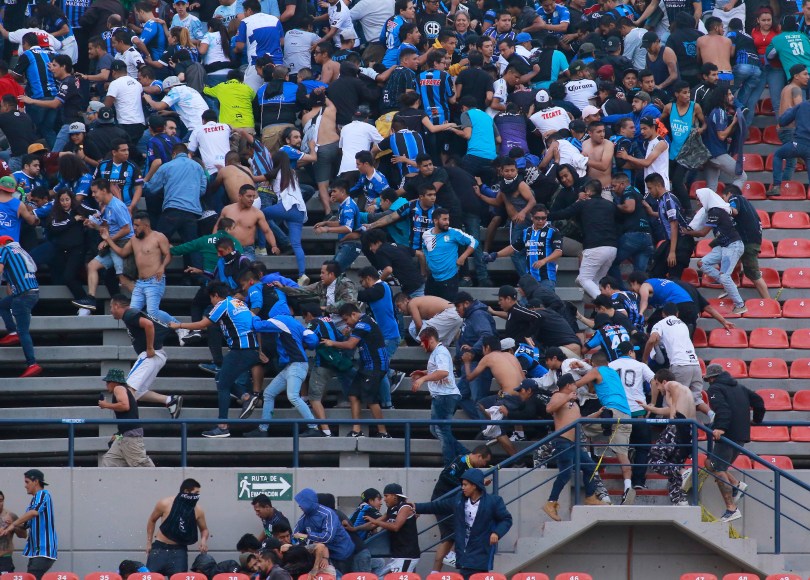
With the shameful scenes witnessed in Veracruz still fresh in the memory, Sunday, October 20 brought further humiliation upon the Mexican game. With Querétaro up 0-2 in the second half of their local derby with San Luís, fights broke out in the stand behind one of the goals between ultras from the two teams. The outnumbered and overwhelmed police could not stop the violence, which saw rocks, trashcans and other improvised weapons being thrown. Various children were caught on camera in tears amidst the tumult. The match was eventually suspended in the 85th minute, as hundreds of fans were allowed to exit the stand onto the field. Some of these fans rushed over to the Querétaro players, who they began verbally abusing and pushing as they tried to get to their locker room.
It would be bad enough for Liga MX if both of these incidents had happened in isolation. Unfortunately, however, the incidents in Veracruz and San Luis reflect a pattern of incompetence and lack of foresight on the part of league executives over a period of years. Evidence of Veracruz owner Fidel Kuri failing to pay players and staff on time was made public as early as August 2018, when then head coach Guillermo Vázquez resigned over three months of unpaid salaries for him and his coaching staff. In April 2019, FIFA docked Los Escualos six points after formation rights owed to Uruguayan club Montevideo Wanderes for the free transfer of midfielder Matías Santos went unpaid.
A month later, Veracruz were relegated after accruing zero points in the Clausura 2019. Yet, in March 2018 the league decided to abolish relegation until the beginning of the 2020-21 season in an effort to increase the number of Liga MX sides from 18 to 20. Instead of going down to the Ascenso MX, the team relegated at the end of the Clausura 2018, Clausura 2019 and Clausura 2020 would be able to pay $6.4 million to keep their place in the top flight. Even with Kuri’s history, plus the fact that he yet again owed up to a month of player and staff salaries by May 2019, he was allowed to deposit the $6.4 million with the league to keep Veracruz up. Five months later, Liga MX officials were left to deal with the public relations disaster seen in the Veracruz-Tigres match, a disaster that could have been avoided if they had denied Kuri the chance to make the $6.4 million payment.
Liga MX officials are also culpable for the violence during the San Luis-Querétaro match. The lamentable scenes were not the first violent incident at Liga MX matches in recent years. Atlas ultras stormed onto the field during the second half of their 4-1 loss to city rivals Chivas in the second leg of their Clausura 2015 Liguilla quarterfinal, attacking both players and Rojinegros coach Tomás Boy. Fights in the stands broke out between Veracruz and Tigres ultras during their matchup in round 7 of the 2017 Apertura, with bottles and other objects thrown at Tigres players as they tried to leave the field. Further incidents have occurred outside Liga MX stadiums, with fan bus attacks and street fights between rival fans becoming commonplace.
Yet, the league has seemed uninterested in laying down sanctions severe enough to eradicate the bloodshed. San Luis were forced to play their final two Apertura 2019 home matches behind closed doors following the October 20 debacle, with both teams fined a paltry $26,163. Furthermore, ultra groups for both teams were banned from home and away matches for the remainder of the season. However, until teams start receiving points deductions and violent fans are banned from all Mexican stadiums for life, the culture of brutality is unlikely to cease.
Beyond the damaging off-field issues, the league’s decision to further strengthen ties with MLS promises to hurt the quality of play in Liga MX in the medium and long term. Following Liga MX’s decision in late 2016 to take their teams out of the CONMEBOL Copa Libertadores because of scheduling conflicts, new tournaments have been announced in the last few years that pit MLS sides against Liga MX clubs. The Campeones Cup, essentially a Super Cup between the winner of the previous years MLS Cup and the winner of the Liga MX Campeon de Campeones (Mexican Super Cup), was introduced in March 2018. A little more than a year later, MLS and Liga MX created the Leagues Cup, a direct knockout competition that has expanded to 16 teams for its second edition. Finally, on November 20 Liga MX President Enrique Bonilla and MLS Commissioner Don Garber announced the first-ever MLS-Liga MX All-Star Game, which is scheduled for July 2020.
Money has been the key factor behind these decisions from Liga MX. All of the Campeones Cup and League Cup matches are played in the United States, where gate revenues are higher than they are in Mexico, with Mexican-American fans desperate to connect with their homeland by paying to watch their favorite club side. The league’s decision to eschew competitiveness in order to line their pockets was clear even before the various MLS-Liga MX tournaments were announced. Upon leaving the Copa Libertadores, Enrique Bonilla justified the decision by saying that “Mexican clubs would have to play 14 games in two months” if they combined their domestic commitments with the Libertadores, saying that “there isn’t a club that can handle that”. Bonilla’s comment ignores the fact that many European clubs play two games a week throughout the season, as they juggle league and domestic/European cup commitments.
The lack of quality in CONCACAF has been a major reason why the Mexican National Team has failed to make it past the round of 16 in a World Cup since they hosted in 1986. Although MLS is constantly improving, it still offers up an on-field product that pales in comparison with the level of Liga MX. Yet, Bonilla and other league officials seem determined to make Liga MX a mirror image of the country’s national team: a giant in their region but mediocre on the international stage. Considering the amount of money in Liga MX, the passion of Mexican fans and the sheer size of the country, Liga MX has the potential to be so much more.
 Just for Kicks