
 Posted by
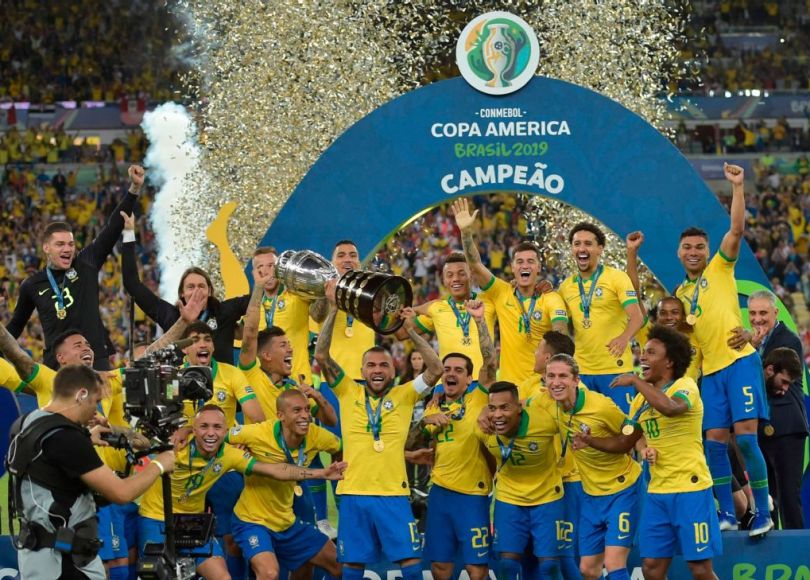
 Brazil’s 3-1 win over Peru brought an end to the Copa América 2019, with South America’s national teams now off until the next FIFA window in September. With that in mind, here are my power rankings of the CONMEBOL teams looking ahead to the start of World Cup qualifiers in March and the Copa América 2020:
- Brazil
After going through this Copa América undefeated, and without conceding a goal until Paolo Guerrero’s penalty in the final, Brazil have cemented their status as South America’s strongest national team. Unlike typical Brazilian sides, this iteration of La Canarinha are better defensively than they are going forward. Since ex-Corinthians coach Tite took over in September 2016, Brazil have conceded only 11 goals in 42 matches, making them the most difficult FIFA top-20 side to score on in that time frame. Tite has been incredibly clever in his squad selection at the back, choosing to include in his back four three of PSG’s starting back four (Dani Alves, Marquinhos and Thiago Silva). This means that Brazil is more organized and well drilled defensively than the average national team, given how well the players know each other. Furthermore, Brazil possess one of the world’s best goalkeepers in Alisson, who dealt comfortably with the little work he was given during the tournament.
Although function triumphs over flair in this Brazil team, Tite will be pleased with how his attack came together in the latter stages of this Copa América. Even though they scored eight goals in the group stage, three of those came against a terrible Bolivia side, while the first two goals in their 5-0 rout of Peru were the result of mistakes by Incas keeper Pedro Gallese. In the quarterfinal against Paraguay, Brazil were held scoreless over the 90 minutes before advancing on penalties.
That match was the nadir for Manchester City forward Gabriel Jesus. When Tite became coach, his first big decision was to start the then Palmeiras teenager Jesus at center-forward. The decision paid immediate dividends, with Jesus scoring a double in a comprehensive 3-0 victory away to Ecuador. From there, Brazil dominated the South American qualifiers, going undefeated over their final 12 matches. However, Tite chose to start Roberto Firmino through the middle in this Copa América, pushing Jesus out wide to the right. Against Paraguay, Jesus wasted numerous promising positions with a poor final pass or errant finish. Yet, he turned his poor form around in the semifinal and final, proving decisive with two goals and two assists over those two matches, including the winner against Peru.
The major concern for Tite heading into the Qatar 2022 qualifiers will be the right-back position. Although Dani Alves won tournament MVP, confirming that he is still one of the world’s best right-backs at 36, he will not be able to play forever. His current back up is Corinthians defender Fagner, who only has 9 caps to his name at age 30. Moreover, Fagner was torched by Eden Hazard in Belgium’s 2-1 quarterfinal victory last summer, with the new Real Madrid winger completing all 10 of his attempted dribbles. Yet, even if Alves cannot make it to Qatar, Tite has a squad capable of lifting the World Cup trophy in 2022.
- Argentina
Heading into their quarterfinal matchup with Venezuela, Argentina had won only 5 of their previous 18 matches against CONMEBOL opposition. Beyond creating doubts that they could progress into the latter stages of this Copa América, La Albiceleste’s poor performances against Colombia and Paraguay raised concerns over their ability to qualify for Qatar 2022. Yet, after wins against Venezuela and Chile and a narrow defeat to the hosts in their final three matches of the tournament, Argentina leave Brazil in a much stronger position than when they arrived.
Paradoxically, Argentina’s wealth of attacking talent has been problematic in recent times. Multiple coaches have struggled to find a formation that gets the best from La Albiceleste’s attacking stars, especially Lionel Messi, while not compromising the side’s defensive solidity. While Argentina looked ragged defensively at times in Brazil, particularly in their first two group matches, coach Lionel Scaloni seems to have found a system that maximizes his team’s attacking threat. Scaloni set his team up in a 4-4-2 from the start against Colombia and Paraguay. Yet, the formation left the front two extremely isolated, with Messi having to drop deep into midfield in order to pick up possession.
However, with Argentina a goal down at halftime in the pivotal Paraguay match, Scaloni brought on Sergio Agüero to partner Messi and Lautaro Martínez up top. From there, Argentina’s attack was far more effective for the rest of the tournament. Although Messi and Agüero were not at their best, with the former in particular struggling with the lamentable state of the Brazilian pitches, Martínez confirmed his status as a national team star, with brilliant performances against Venezuela and Brazil in the knockout stages.
Martínez was not the only player who will have gained confidence from their showings in Brazil. Juventus attacker Pablo Dybala, who had previously struggled to adapt to the pressure of playing for Argentina, looked lively coming off the bench throughout the tournament before scoring a well-taken goal in the first half of the third-place match against the Chileans. In midfield, Leandro Paredes showed both personality and an impressive passing range, suggesting he could become a mainstay in the defensive midfield position. Farther back, young Tottenham defender Juan Foyth impressed as a makeshift right-back, with his outstanding composure on the ball.
The various stand-out individual performances, coupled with the news that Scaloni will be staying on for the qualifying process for Qatar, means that Argentina suddenly have a stability that they had lacked since the departure of Gerardo “Tata” Martino as coach after the 2016 Copa América. Although Scaloni is relatively inexperienced and made some questionable substitutions during the tournament, the players, most notably Messi, are behind him. This stability and togetherness in the Argentina squad makes them one of the most dangerous sides in the international game.
- Uruguay
One of only two South American sides to make the quarterfinals in Russia 2018, Uruguay will be dissatisfied with their performance in this Copa América. They won all of their group stage matches, finishing as the second-top scorers of the first phase with seven goals. However, they went out to an unfancied Peru side in the quarterfinals after missing multiple clear-cut chances over the course of the 90 minutes.
Nevertheless, Uruguay will continue to benefit from the talent in their squad as the Qatar 2022 qualifiers approach. The quality of Luis Suárez and Edinson Cavani up top is unquestionable, while further back they are marshaled by the former Atlético Madrid partnership José María Giménez and Diego Godín. Furthermore, they are well coached by Óscar Washington Tábarez. “El Maestro” has been in charge since March 2006, a longevity rarely seen in modern football. This continuity is particularly advantageous in the international game, where coaches have far less time to work with their players than they do in the club game. As a result, Uruguay’s players know exactly what to expect from Tábarez, while the coach knows his players inside-out.
This deep knowledge of the Uruguayan set-up has allowed Tábarez to effectively rejuvenate the midfield in the past two years, with Rodrigo Betancur, Lucas Torreira and Federico Valverde all getting significant playing time. These players have allowed Uruguay to start playing a more expansive and attacking brand of football than they did when they made the semifinals of the 2010 World Cup and won the 2011 Copa América.
Although Uruguay have continued to confound logic by producing a squad packed with quality players in a country with only 3.5 million inhabitants, they unsurprisingly struggle with depth at some key positions. This was seen in Brazil when starting left-back Diego Laxalt suffered an injury that kept him out of the match against Chile and the quarterfinal. A midfielder in his younger days, Laxalt was important to Uruguay going forward thanks to his ability to get into advanced positions and act as an auxiliary midfielder. Without Laxalt, Tábarez was forced to play the right-footed Martín Caceres from the left, with Uruguay’s attacking connections suffering as a result. Regardless, Uruguay have too much talent to miss out on Qatar, and should be one of South America’s strongest representatives at that tournament.
- Colombia
Los Cafeteros were the sensation of the group stage in Brazil, overpowering Argentina 2-0 in their first match before defeating Qatar and Paraguay to take maximum points. However, their loss to Chile, while coming on penalties after a 0-0 draw over 90 minutes, adds weight to the perception that Colombia flatter to deceive in crucial moments. Although they are blessed with a generation containing multiple stand-out players in Europe’s top-5 leagues, Colombia have failed to make the final of any of the last three Copa Américas or advance past the quarterfinal stage in Brazil 2014 or Russia 2018.
Nevertheless, there are multiple reasons for new coach Carlos Queiroz (who took over in February 2019) to be encouraged. Colombia were strong defensively in Brazil, conceding no goals in their four matches. Led by the young center-back duo of Davinson Sánchez and Yerry Mina and the experienced goalkeeper David Ospina, Colombia’s defense should continue to be difficult to breach moving into the qualifiers for Qatar.
Further forward, star midfielder James Rodríguez proved that his indifferent club form over the last few years have not effected his ability to control games for his country. He was majestic against Argentina, with his precise cross-field ball setting up Roger Martínez for the opening goal. His cultured left-foot also picked the lock against a massed Qatari defense, with an inventive outside of the foot cross landing perfectly on the head of Duván Zapata for the 1-0 in the 85th minute. With the continued absence of River Plate man Juanfer Quintero due to a cruciate ligament injury suffered in March, Colombia will need the creative output of Rodríguez even more than usual.
Atalanta striker Zapata’s contributions were also extremely promising. After struggling to break into the side for years due to the talents of Radamel Falcao and Carlos Bacca, among others, Zapata finally established himself as Colombia’s starting center-forward at this tournament. He started and finished a devastating counterattack against Argentina for Colombia’s second goal after coming on as a sub, before heading home against Qatar. Quieroz will likely regret not starting him in the quarterfinal against Chile, instead going with the more experienced Falcao.
Yet, that decision was an anomaly within the context of Quieroz’s attempts to make a place in the Colombian line-up more merit-based than it had been with previous coach José Pékerman. A prime example of this was seen in the right-back position, with Monterrey defender Stefan Medina starting over Atlético Madrid’s Santiago Arías, who had been the starter under Pékerman. With Quieroz’s meritocracy likely to keep his players motivated and on their toes, plus the quality present in the squad, Colombia should qualify for Qatar without too much trouble.
- Peru
In the wake of their cinderella run to the Copa América final, Peru fans will be delighted with coach Ricardo Gareca’s decision to stay with La Bicolor through the Qatar 2022 qualifiers. The Argentinean coach was crucial to Peru’s first World Cup qualification in 36 years (Russia 2018) and their first Copa América final in 44 years. His ability to inspire and motivate his players is matched by an impressive tactical astuteness. Although they were not favored in their semifinal against Chile or the final against Brazil, Peru unexpectedly came out pressing in both matches. This allowed them to dominate the first half of the semifinal and look comfortable against the Brazilians in the first 15 minutes, until a moment of individual brilliance from Gabriel Jesus helped set up the opening goal.
Even with Gareca, Peru rode their luck on the way to the semifinal. They got there having won only one of their four matches, with their only goals coming in the 3-1 victory over lowly Bolivia. A 5-0 thrashing at the hands of Brazil in their final group match meant that Peru had to wait for other results to seal their quarterfinal spot as one of the best third-placed sides. Once there, they were outplayed against Uruguay, not registering a shot on target during the 90 minutes and seeing both Edinson Cavani and Diego Godín miss chances from point-blank range.
Although Gareca has demonstrated his ability to work magic with a limited Peruvian squad, he will be crossing his fingers that talismanic striker Paolo Guerrero can stay fit through the qualifiers for Qatar 2022. At 35, Guerrero is Peru’s all-time leading scorer with 39 goals. The only other reliable goal-getter in the squad, 34 year-old Jefferson Farfán, suffered a serious knee injury during the tournament that will leave him out for 6-9 months. At his age, it is unknown how effectively Farfán will come back from his injury, leaving Seattle Sounders forward Raul Ruidíaz as the main backup to Guerrero. Although he has been prolific at club level for Monarcas Morelia in Mexico and now with Seattle, he has only 4 goals in 40 matches with Peru. If age finally catches up to Guerrero, Peru will struggle to find the goals necessary to make it to Qatar.
- Chile
Although they came into this Copa América looking for their third successive continental title, Chile were not one of the favorites given their surprising failure to qualify for Russia 2018. Following that disappointment, Colombian tactician Reinaldo Rueda took over in January 2018 and began the rejuvenation of an aging Chilean squad.
However, a discouraging 3-0 defeat to regional rival Peru in a Miami friendly in October 2018 forced Rueda to have a rethink. Following that defeat, Rueda reincorporated many of the stalwarts from the 2014 World Cup campaign and the 2015 and 2016 Copa América successes. Only four of the starting 11 from the Miami friendly were present in the starting lineup for Chile’s semifinal against Peru.
The return to the old guard worked for Chile in the early stages of the tournament, as they defeated both Japan and Ecuador before narrowly losing to Uruguay in their third match. In the quarterfinals, they outplayed a Colombia side that had impressed to that point, eventually going through on penalties. Yet, their dreams of a third consecutive Copa América were dashed in the semifinal, where they again lost 3-0 to Peru.
Worryingly for Rueda, Chile’s “golden generation” will not make it to Qatar 2022. Only three of La Roja’s starting 11 in the Peru semifinal were under 30, meaning that the rejuvenation process that Rueda abandoned must happen now. With no clear replacements for stars such as Alexis Sánchez and Arturo Vidal coming up through the ranks, it may be a while before Chile tastes again the success that they found in recent years.
- Venezuela
A traditional lightweight on the South American scene that has never qualified for a World Cup, expectations have been building around Venezuela in the past few years. Venezuela finished runners-up to England at the 2017 U-20 World Cup, with multiple members of that squad having since been integrated into the senior set-up. Beyond the 2017 U-20 World Cup generation, Venezuela went to this Copa América with an extremely young squad in general. Of the players that started in the quarterfinal against Argentina, six were 25 or younger.
Nevertheless, their 2-0 quarterfinal defeat to Argentina exposed Venezuela’s limitations after a promising group stage that saw them draw with eventual finalists Peru and Brazil. Going into the Argentina match, La Albiceleste seemed vulnerable, having scraped through the group phase with a victory over minnows Qatar in their final match. Although they possessed the attacking talents of Lionel Messi and Sergio Aguero, among others, Argentina had been weak at the back in Brazil, showing particular susceptibility down their right side.
Yet, Venezuela coach Rafael Dudamel erred in his tactical set-up, playing a defensive 4-5-1 that left striker Salomón Rondón isolated up top. After going down in the 10th minute to a Lautaro Martínez strike, Dudamel waited too long to take the hand brake off, with La Vinotinto not truly threatening the Argentine goal until winger Yeferson Soteldo was brought on for defender Luis Mago in the 56th minute. In order to qualify for Qatar 2022, Venezuela will have to start believing that they can damage the continent’s best sides when playing on the front foot. If Dudamel continues with his conservative tactical approach, Venezuela are unlikely to make it to Qatar.
- Paraguay
Although they failed to win any of their group games, Paraguay benefitted from the extremely forgiving format of the Copa América, qualifying with 2 points as one of the best third-placed teams. Even though they were eliminated in their next match against Brazil on penalties, Paraguay showed enough at this tournament to suggest that they will be a tough proposition for any side in the Qatar 2022 qualifiers.
After the extremely brief reign of former Mexico coach Juan Carlos Osorio, Argentinean Eduardo Berizzo took over the National Team job this past February. He inherited a squad low on quality compared to the generation that made the knockout stages at the 2006 and 2010 World Cups, with only center-back Fabian Balabuena (West Ham) and attacking midfielder Miguel Almirón (Newcastle) starting for European club teams last campaign.
Nevertheless, Berizzo will have been encouraged by Paraguay’s showings against regional giants Argentina and Brazil. Against La Albiceleste, Paraguay created problems for Lionel Messi and company, taking the lead in the first half after a brilliant run and cross from Almirón before settling for a 1-1 draw. It was not until Argentina coach Lionel Scaloni brought on a third attacker in the shape of Sergio Agüero that Argentina began to control the game and find the equalizer, although Paraguay held on comfortably for the point in the final twenty minutes. In the match against Brazil, Paraguay sat even deeper than they had against the Argentines, waiting for opportunities to break on the counter or for set pieces to send their center-backs forward. While they never really looked like scoring, Paraguay defended efficiently, limiting the number of clear-cut Brazilian chances to a minimum.
While Berizzo will have left the Copa América knowing that his squad has kept intact the traditional Paraguayan ability to defend stoutly in a deep block, their lack of attacking invention will likely cost them over the course of the 18-match qualifying process for Qatar. Paraguay are far too reliant on the considerable creative talents of Almirón for inspiration in the final third. As a result, it is unlikely that they will score enough goals to book a place in the 2022 World Cup.
- Ecuador
After qualifying for the 2014 World Cup and getting off to a flying start in the qualifiers for Russia 2018, Ecuadorian football seemed to be on the rise again after the country’s absence from South Africa 2010. Ecuador sat in first place in the Russia 2018 qualifiers after five matches, and were in 3rd place with two-thirds of the matches played. However, the wheels fell off after La Tricolor’s 3-0 victory over Venezuela in round 12. From there, Ecuador failed to register another point, losing all three of their matches in the high-altitude stronghold of Quito.
In response to the frustration of their 2018 qualifying campaign, the Ecuadorian Football Federation brought back Hernán Dario Gómez for a second stint at the helm of the La Tricolor. In his first spell in charge, “Bolillo” had become a national hero, guiding Ecuador to their first World Cup in South Korea/Japan 2002. Nevertheless, his second term has been an unmitigated disaster so far.
Although they were not favored to advance out of a strong group containing Uruguay and Chile, Ecuador’s showings at this Copa América were extremely disappointing. They were blown away in their first match against Uruguay, down three goals and a man by halftime on the way to a 4-0 defeat. Although they competed better in the 2-1 loss to Chile in the second group match, they failed to beat the glorified U-23 squad fielded by Japan, only drawing 1-1 where a win would have seen them qualify for the quarterfinals. Along the way, Bolillo’s defensive tactics and claims that the Copa wasn’t a priority for Ecuador rankled with fans and press back home.
When it seemed like things couldn’t get worse for La Tricolor, their Copa América campaign devolved into farce when six players were accused of acts of indiscipline in the team hotel following the final match against Japan. The misbehavior off the pitch, coupled with the lamentable performances on it, cost Bolillo his job, with the Ecuadorian Football Federation letting him go this week. Rumors have indicated that former Chile and Argentina coach Jorge Sampaoli is a candidate for the job, with Edgardo “El Paton” Bauza also being mentioned in some reports. Regardless of who takes over, they will inherit a squad that has morphed from a source of national pride into a national embarrassment.
- Bolivia
The most damning indictment of Bolivia’s performance at this Copa América is that it was no surprise – La Verde finished dead last in the competition, losing all three of their group matches and scoring only two goals in the process.
The failure at this Copa América comes in the wider context of poor Bolivian showings in South American qualifiers. Although they have the advantage of playing in the high altitude of the Estadio Hernan Siles (11,735 feet above sea level), Bolivia have not come close to qualifying for a World Cup since they made it to USA 1994. The altitude seems to hurt the Bolivians rather than help them. Instead of building on their home field advantage by developing a squad that can compete when visiting the other CONMEBOL nations, Bolivia have a side that can only find success in La Paz. For example, all of the 14 points that the Bolivians gained in the Russia 2018 qualifiers came at home.
Unfortunately for Bolivia fans, the distinct lack of quality in their squad means that they have no chance of qualifying for Qatar 2022. Only three of the players in the Copa América 2019 squad play outside Bolivia, with none plying their trade in a top-five league in Europe. As a result, the best Bolivia fans can hope for in the next few years is for their team to take points off of better CONMEBOL sides in the altitude of La Paz.
 Just for Kicks