
 Posted by
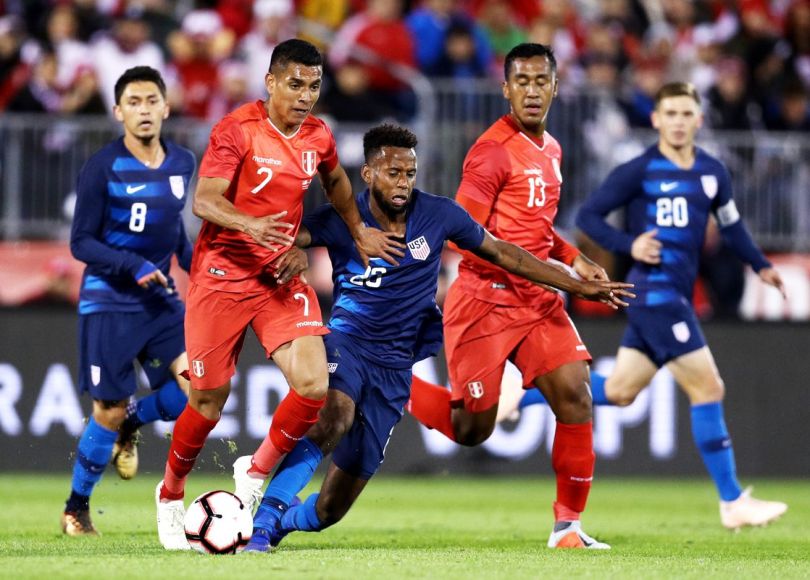
 Here are my three takeaways from the 1-1 draw between Peru and the United States in East Hartford, with an Edison Flores strike in the 86th minute canceling out Josh Sargent’s early second-half goal for the Stars and Stripes.
Peru Must Find Guerrero Replacement
During their inspirational qualification campaign for Russia 2018, Peru relied heavily on star forward Paolo Guerrero. The former Bayern Munich man was Peru’s co-top scorer during the CONMEBOL qualifiers with 5 goals. Furthermore, Guerrero appeared in 17 of Peru’s 18 matches during CONMEBOL qualifying. Beyond his crucial role on the field for Peru, Guerrero was vital in the dressing room, serving as team captain and inspiration for his entire nation.
However, Guerrero is 34 years old, and unlikely to make it to Qatar 2022. Although he could help the team at this summer’s Copa América and in the World Cup qualifiers for Qatar, Peru must think about how to replace Guerrero. As a result, Seattle Sounders forward Raul Ruidíaz has started up top for Peru’s last three friendly matches, including this game.
Ruídiaz has been prolific at the club level in the last few years, scoring more than a goal every two games for Morelia and Seattle. Yet, he has struggled with the national team, with only four goals in 34 caps. He has not scored in any of his three national team starts since the World Cup, which has provoked criticism from Peruvian supporters.
Against the United States, Ruídiaz was a peripheral figure, barely getting on the ball and not having a clear-cut chance during the entire match. Ruídiaz seemed reluctant to come and check in for the ball, instead opting to hang on the last man in the American backline. Even though Peru dominated possession, with large swathes of the match played in the American half, Ruídiaz struggled to get involved. Although he is a good header of the ball, Ruídiaz’s short stature means that he cannot provide the same hold-up play that Guerrero did. He will have to change his game somewhat from a penalty box predator to a more complete forward in order to better mesh with Peru’s possession-based style.
US Adjustments Produce Better Second Half Performance
American coach Dave Sarachan made a whopping nine changes for this match, with Tim Weah and Kellyn Acosta the only starters who also began against Colombia. Unsurprisingly, the Stars and Stripes struggled for fluency in attack for much of the first half. Defensively, the team sat deeper and deeper as the half went on, with the whole team camping inside their own third at times. This put a lot of pressure on lone forward Josh Sargent, who looked lively the few times he had the ball in the attacking third, but otherwise was forced to defend.
At halftime, Sarachan decided to adopt a more aggressive tactical outlook. The Americans moved their defensive block higher up the field, and began pressuring the Peruvian defenders and midfielders when they tried to play the ball out of the back. Moreover, Sarachan instructed his full-backs to push into the attack. These tweaks gave the US more possession in the attacking third, and helped to create the game’s first goal.
After right-back Reggie Cannon carried the ball into Peru’s defensive third, he played the ball back for fellow debutant Jonathan Amon, who was fouled as he tried to dribble away from Peruvian pressure. From the resulting free kick, Acosta played the ball low towards the penalty spot for the run of Sargent, whose first-time shot took two deflections before nestling in the bottom corner of the Peruvian net. Even though they had barely had a sniff at goal up until then, the Americans’ change in approach after halftime had put them in the lead within five minutes of the second half.
Following the goal, the Americans continued to pressure higher up the field and incorporate their full-backs into the attack. They also brought on another forward to accompany Sargent when Julian Green replaced Amon in the 54th minute. Although Peru eventually retook control of the match midway through the second half and began to threaten the American goal before their late equalizer, the United States should stick to the adventurous approach that they showed after halftime.
Gareca Reaches Milestone
This match represented Peruvian coach Ricardo Gareca’s 50th in charge of la Blanquirroja. When he took over in March 2015, Peru had not been to a World Cup since Spain 1982, and were over-reliant on established players such as Claudio Pizarro and Juan Manuel Vargas for inspiration. Peru took only 4 points from their first 7 CONMEBOL Russia 2018 qualifiers, leading to calls for Gareca’s dismissal. The team caught fire thereafter, however, taking 26 points from the remaining 11 matches to claim 5th spot in the table and a play-off against New Zealand. After winning the two-legged playoff, Peru qualified for their first World Cup in 36 years, and Peruvian football could celebrate their biggest-ever triumph.
Unsurprisingly, such an achievement brought Gareca into the spotlight. He reportedly garnered interest from the Mexican and Argentinean federations to take over their respective national teams. However, Gareca decided to stay put, and recently signed a contract extension with the Peruvian federation through the Qatar 2022 qualifying cycle.
Although Peruvian players have long been known for their technical quality, Gareca has managed to instill a belief and togetherness in the national team that had not existed before. Even after the World Cup qualification success, the Peruvians are still hungry for more. This was demonstrated by their convincing 3-0 friendly win last week over local rivals Chile in the “Clásico del Pacifico”.
In the U.S. match, the Peruvians continued to probe for holes in the American defense through patient buildup play, even as they were 1-0 down late in the second half. Eventually, this belief paid dividends with Flores’ equalizer.
Gareca’s attempts to qualify Peru for their second consecutive World Cup will be boosted by the increased profile of his players. Numerous squad members have moved to Liga MX recently, which will improve the overall quality present within the national team.
 Just for Kicks