
 Posted by
 After 64 matches over more than a month, the 2018 World Cup has, unfortunately, come to a close. With almost a month until the major European leagues start up again, now is an appropriate time to take stock of Russia 2018. Although FIFA announced award winners at the end of the tournament, everyone knows that the World Cup awards that really count are the ones decided by Just For Kicks. So without further ado, here are my 2018 World Cup awards.
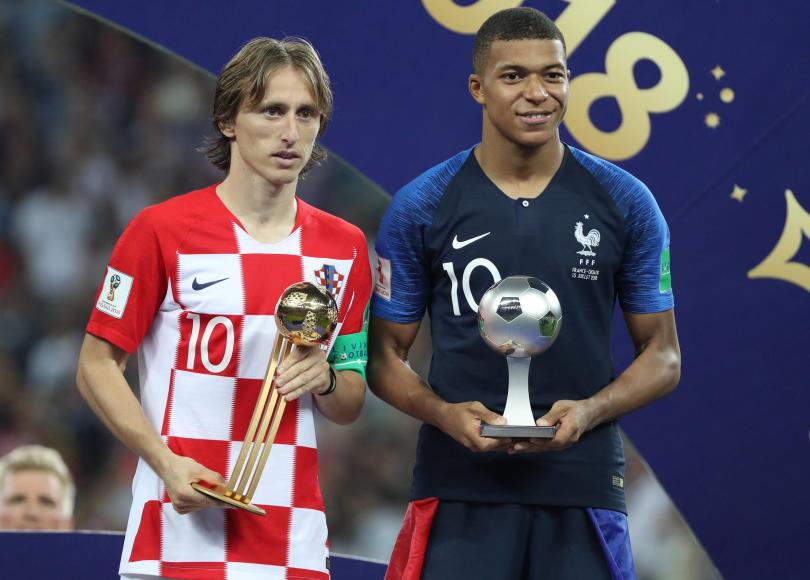
Best Player: Luka Modric
Long considered to be one of the best midfielders in the world, Luka Modric had triumphed repeatedly with his club, Real Madrid, in the years leading up to the 2018 World Cup. Although he was a key factor in Real’s conquest of three Champions League titles in four years, success at the international level had continuously eluded Modric. Over three Euros (2008, 2012, 2016) and the 2014 World Cup, Croatia had never advanced past the first knockout round. With a 32-year old Modric preparing for his second and quite possibly last World Cup in Russia, the pressure was on the former Tottenham man to lead his country to glory.
Switching between a deep midfield position and the number 10 role, Modric was Croatia’s creator-in-chief, and handled this responsibility impressively. In the six games leading up to the final against France, Modric created 16 chances, twice as many as any of his teammates. Furthermore, the diminutive playmaker averaged nearly ten passes more a game in Russia (69.3) than he averaged with Real Madrid during the 2017/18 La Liga Season. Although Modric carried more of the creative burden for Croatia than he does in Madrid, he still used the ball very efficiently. Modric maintained an 87% pass success rate during the tournament, completing 90% of his passes in the final against France. In addition to his brilliance in possession, Modric contributed two goals to the Croatian cause in the World Cup, including a spectacular solo effort against Argentina.
While his technical ability was already established before this World Cup began, Modric’s performances in Russia also underlined his world-class mental fortitude. After missing a crucial penalty deep into extra time of Croatia’s round of 16 match with Denmark, Modric stepped up to the spot again minutes later in the penalty shootout. This time, Modric was successful with his spot kick, and Croatia went on to win the shootout and advance to the quarterfinals. While most of the players on the field in the Croatia-England semifinal were tiring towards the end of regular time and into extra time, Modric seemed to get stronger physically, appearing all over the field as his team sought a winning goal. Besides being his nation’s most gifted player, Modric showed himself to be Croatia’s on-field leader.
Best Young Player: Kylian Mbappé
Before this World Cup, Kylian Mbappé was already viewed as one of the best young talents in world football. Scintillating performances with Monaco during the back half of the 2016-17 season led to a $209 million move to PSG. Mbappé enjoyed a solid debut campaign in the French capital alongside Brazilian star Neymar, who many consider to be the heir apparent to Lionel Messi and Cristiano Ronaldo. However, Mbappe’s role in France’s second World Cup triumph has demonstrated that he has the potential to be better than all three of those players.
Mbappé helped himself to 4 goals in 7 matches in Russia, including a double in France’s 4-3 win over Argentina in the round of 16. Along the way, the Paris-born forward set numerous records. Mbappé’s strike in France’s group stage match against Peru made him the first teenager to score for France at either a World Cup or Euro. Even more impressively, Mbappé became only the second teenager, after Pele in 1958, to score a goal in a World Cup final when he slotted home France’s fourth against Croatia.
In addition to his record-setting goal scoring, Mbappé terrorized opposing defenses with his speed and dribbling ability. These attributes were on full display during the teenager’s barnstorming run from his own half against Argentina. After running through the Argentine midfield, Mbappé was scythed down in the box by defender Marcos Rojo, giving France a penalty. Throughout the tournament, Mbappé often appeared as France’s most advanced player in coach Didier Deschamps’ 4-2-3-1 system. This gave the French a turbo-charged outlet from which to launch counterattacks, a tactic they used repeatedly in Russia.
Biggest Shock: Germany Eliminated in Group Stage
Before this World Cup, three of the previous four champions had been eliminated in the group stages of the following World Cup. However, this trend was not expected to continue, given that Germany would be defending their 2014 title in Russia. The Germans had been eliminated in the first round of a World Cup only once, way back in 1938.
Although they have always been known for their ability to perform on the big stage, Germany’s major tournament pedigree had improved further under coach Joachim Low. Since taking over for Jurgen Klinsmann in July 2006, Low had led Germany to at least the semifinals of every European Championship or World Cup they played. Furthermore, the Germans won the 2017 Confederations Cup with a second-team made up mostly of young players. In qualifying for the World Cup, Germany won all 10 of their matches, scoring a European qualifying record 43 goals and conceding only four times.
However, unconvincing performances in pre-World Cup friendlies foreshadowed a dire tournament for the Germans. Placed in Group F with Mexico, Sweden and South Korea, the Germans were stunned in their opening match, losing 1-0 to the Mexicans. Although they rebounded in their second game with a last-gasp 2-1 victory over Sweden, an already-eliminated South Korea managed to stifle the German attack in the third match, scoring two late goals to claim a 2-0 win. Amazingly, Germany finished last in a group that they were expected to cruise through.
Best Goal: Benjamin Pavard vs. Argentina
In Russia 2018, 169 goals were scored, only two behind the record 171 scored in France 1998 and Brazil 2014. With all the goals flying in, few would have expected the best goal of the tournament to come from a reconverted center back who had only six caps for his national team before the World Cup began.
Only four players contested every minute of the 2017-18 Bundesliga season. One of those players was young Frenchmen Benjamin Pavard, who spent most of his time at center back with Stuttgart. However, after receiving his first senior national team appearance in November 2017, Pavard was used at right back by French coach Didier Deschamps. In Russia, Pavard started six of his country’s seven matches in this position. On his ninth cap in France’s Round of 16 matchup against Argentina, Pavard managed the best goal of this World Cup, becoming the first French defender to score at a World Cup since Lillian Thuram in 1998.
Running onto a bouncing ball, Pavard met the ball just outside the top of the box. By slicing across and underneath the ball with his right foot, Pavard created a wicked backspin on the ball that saw it rise into the top corner, beyond the despairing dive of Argentinean keeper Franco Armani. Although the shot was not struck as hard as many goals scored from outside the box, Pavard’s exquisite technique rendered Armani helpless.
Pavard’s strike could not have come at a more important time for his team. Having gone into the match as favorites over the Argentines, France struck first via an Antoine Griezmann penalty in the 13th minute. However, Argentina had turned the game around by the 48th minute, taking a 2-1 lead through Gabriel Mercado. Staring down the barrel of elimination, Pavard, perhaps France’s most unlikely scorer, stepped up to bring his country level.
Most Entertaining Team: Belgium
Under former coach Marc Wilmots, Belgium had been a dark horse at both the 2014 World Cup and Euro 2016. Boasting an enviable array of talent including Eden Hazard, Romelu Lukaku and Vincent Kompany, the Belgians were expected to impress at both of those tournaments. Instead, they disappointed, going out at the quarterfinal stage in Brazil and France.
After taking over for Wilmots following Euro 2016, former Everton boss Roberto Martinez implemented an attacking 3-4-2-1 formation. This tactical change improved Belgium’s offensive fluidity in Russia. The Belgians were the top-scoring team at the 2018 World Cup, netting 16 goals in 7 games, or 2.3 a game. During 10 games under Wilmots at the 2014 World Cup and Euro 2016, Belgium scored only 1.5 goals a game.
Although they were impressive going forward, Belgium proved vulnerable in the back. This combination of offensive excellence and defensive vulnerability made Belgium games must-see viewing. Two of the tournament’s best matches involved the Belgians. In the round of 16, Japan took a shock 2-0 lead in the second half. However, Belgium roared back, leveling the game at two before eventually finding the winner on a lightning counterattack in second half extra time. Facing Brazil in the quarterfinals, Belgium put on a counterattacking masterclass in the first half to take a 2-0 advantage into the break. After conceding a Renato Augusto header midway through the second half, the Belgians were besieged by Brazilian pressure for the remainder of the match, barely holding on to advance to the semifinals.
 Just for Kicks