
 Posted by
 On February 2nd of this year, the Philadelphia Eagles played the New England Patriots in the Super Bowl, with Philadelphia registering an upset 41-33 win. The game was watched by a reported 103.4 million people in the United States, with an estimated 150 million watching worldwide.
Although the Super Bowl is the biggest sporting event in the United States, the international interest in the game pales in comparison to soccer’s premier event, the World Cup. A staggering 3.2 billion people reportedly watched the games of the 2014 World Cup in Brazil, while an estimated 1 billion watched the final between Germany and Argentina. Although soccer is the world’s most popular sport, this fact alone does not explain the popularity of the World Cup. There are multiple factors that cause people to love the World Cup, and those factors go far beyond the game of soccer itself.
The World Cup sees the best players from the 32 participating nations competing against each other for the championship. This creates a built-in fan base for the tournament, as there is intense interest from these 32 countries regarding the performance of their team. At the World Cup, rooting for your home country has nothing to do with political affiliation, as everyone is united behind the national team, even if they dislike the national government. For example, outgoing Mexican president Enrique Peña Nieto had a 21% domestic approval rating as of March 2018, the lowest in Mexican history. However, everyone in Mexico was behind El Tri during the World Cup. French president Emmanuel Macron’s domestic approval rating was recently reported to be 32%, but that has not stopped virtually everyone in the country from supporting Les Bleus run to the final of this year’s tournament.
Furthermore, fans whose home country fails to qualify for the World Cup or is eliminated early on in the tournament often have a second country they support. After being eliminated in the round of 16 at this year’s Cup, many Argentineans were pulling for neighbors Uruguay in their quarterfinal match against France. Brazil, which has won more World Cups than any other country with five, are many people’s second team because of their previous World Cup success and attacking style of play. At this World Cup, many Americans were rooting for their southern neighbor, Mexico, in an act of political solidarity against the Trump administration and its anti-Mexican stance.
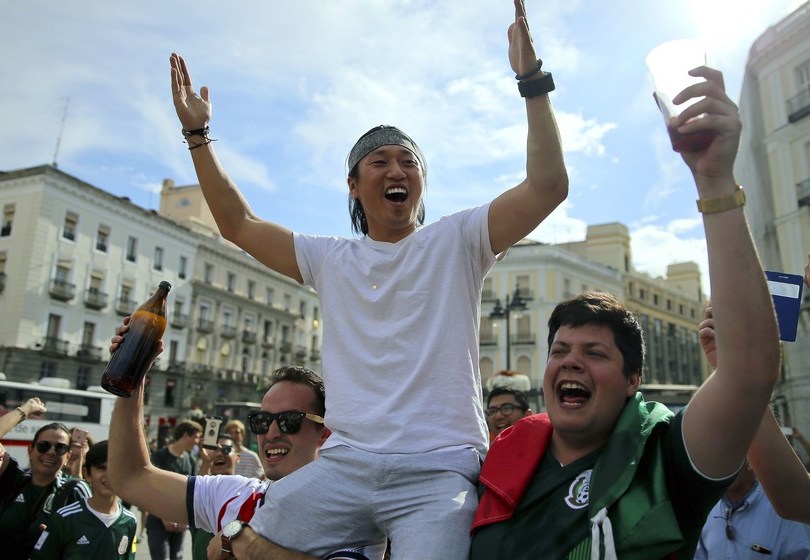
One would think that different countries playing against each other, with so much worldwide attention, would generate divisive nationalistic fervor. However, the World Cup actually serves to unify people from diverse backgrounds, at both the national and international level. Many of the national teams participating in the World Cup represent the diversity within their countries. For example, 17 of the 23 players selected for France’s 2018 World Cup squad are the sons of first-generation immigrants. The heterogeneity of the French squad contradicts the growing current of far-right, anti-immigrant thought in the country represented by politicians such as the National Front’s Marine Le Pen. Many teams’ fans have also been known to embrace and celebrate international diversity. After South Korea’s upset win over Germany ensured Mexico’s spot in the Round of 16 at Russia 2018, a large group of Mexican fans gathered in front of the South Korean embassy in Mexico City. The fans repeated the chant “Korean, brother, you are now Mexican” and lifted embassy workers onto their shoulders in celebration.
Furthermore, during the World Cup, the host country becomes a melting pot of people from different nations and cultures. One-and-a-half million tourists were expected to visit Russia for the World Cup, with tens of thousands of fans coming from as far as Peru and Colombia to support their team. The interaction between fans from all over the world has been intensified by the travel procedures in place for the World Cup. Many of the flights from one host city to another have had layovers in Moscow, while trains between host cities are free for those with the relevant match tickets, allowing the Moscow airport and the Russian train system to become real cultural meeting points.
In addition to its cultural relevance, the World Cup has the power to effect politics. For example, Russian President Vladimir Putin, who has become increasingly isolated on the world stage following his annexation of Crimea in 2014, has hosted meetings with no fewer than seven high-level officials from other countries in the tournament’s first weeks, in an apparent attempt to soften his image and increase his international visibility. In addition to meeting with Putin, most of the leaders, such as Panamanian President Juan Carlos Varela and South Korean President Moon Jae-In, were also in Russia to support their country’s national team and see them in action.
While politicians like Putin have associated themselves with the World Cup to satisfy their own agendas, footballers have also used the World Cup to powerful political effect. After Ivory Coast qualified for their first World Cup in October 2005, their star forward Didier Drogba pleaded for an end to the civil war that had been ravaging the country since 2002. Thanks to Drogba’s pleas and the team’s World Cup qualification, a peace agreement between the government and New Forces opposition was eventually reached in early 2007. If the World Cup is beloved enough to help put an end to a brutal civil war, it is no surprise that it is more popular than the Super Bowl.
 Just for Kicks